AI-powered student reflection and counselor-ready context for grades 9-12
The student record that actually listens · Grades 9–12 · Counselor-led
Everything you know about a student.Finally working together.
Addie brings student conversations, teacher comments, counselor notes, writing samples, school records, and tasks into one living Student Ledger—so counselors spend less time searching and more time advising.
Book a demoSee the student and counselor experience
Get startedConfigure your grades, dates, and launch plan
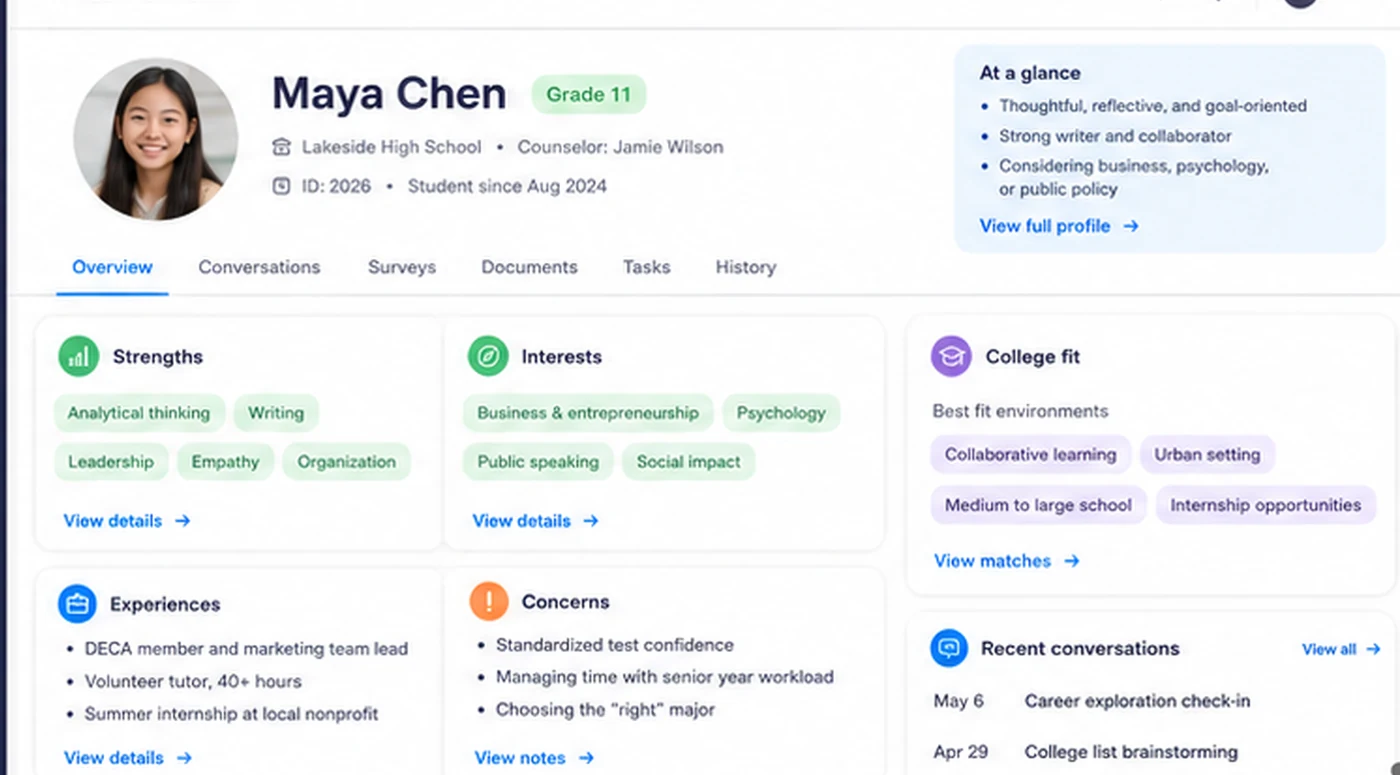
Fictional counselor view
Stop rebuilding the student from scattered files
Start meetings and recommendations with context
See how the student’s story develops across four years
Trusted by leading counseling teams
Used by 70+ schools in the U.S. and internationally, including leading ACCIS schools applying Addie to real student and counselor workflows.
132 of 140Lakeside juniors completed ten conversations
1 weekfrom UPrep setup to counselor use
50%+ lessrecommendation preparation at The Pingry School
See Addie through the eyes of counselors
Three respected independent-school counseling teams show how Addie supports real students, real meetings, and real recommendation work.
Lakeside School, University Prep, and The Pingry School are active Addie power users with different starting points and the same goal: more context and more room for human counseling.
Ari WorthmanDirector of College Counseling, Lakeside School
Before: a static junior questionnaire. After: ten guided conversations and richer meetings.
“I didn’t initially think of AI as helping us get to know students better. It’s become fascinating to see how it can help with the qualitative parts of our jobs.”
132 of 140juniors completed
600+ hoursstudent context
4.5+ hoursaverage reflection per completer
Most useful workflows
Ten themed conversations replaced the junior questionnaire.
Summaries, teacher comments, grades, and notes prepared counselors before meetings.
The same Ledger supported recommendations, college suggestions, career exploration, and rapid refreshers.
“It probably cut my recommendations down from three to four hours to an hour and a half.”
Kelly HerringtonDirector of College Counseling and Student Services, University Prep
Before: an existing senior inventory. After: a familiar workflow with deeper counselor context.
“One of the people who gave me the most pushback, within a week, said: ‘I can’t do my job now without this.’”
1 weekfrom setup to use
Existing inventorybecame the entry point
Skeptic → advocatewithin one week
Most useful workflows
Surface what a counselor might otherwise overlook, with direct teacher evidence.
Turn memorable details and student voice into recommendation material.
Use the student’s own words to scaffold essay-direction conversations.
Summarize notes into Scoir so colleagues can continue the story.
“What will I miss or overlook as a counselor that is secretly awesome about this student?”
Joe KinneyThe Pingry School
Before: student evidence scattered across forms and notes. After: one daily counselor workflow.
“I’m not using it to write the letter. I’m using it to help me really structure the letter.”
295 hoursstudent reflection
1.06M wordsstudent-authored
50%+less recommendation prep
Most useful workflows
Bring student conversations, parent letters, staff reflections, counselor notes, and forms into one Ledger.
Check each morning which students have enough reflection to begin a letter.
Identify openings, central stories, evidence, quotations, and conclusions while retaining authorship.
Use Addie for meeting preparation, essay direction, and recommendations alongside Scoir.
“In the morning, one of the first places I go is Addie… ‘That means I can probably start her letter.’” — Amy Cooperman
What Addie actually does
The Student Ledger is the star of the show.
Student voice, school context, and counselor knowledge flow into one living record. That record then powers the work counselors need to do better.
1 What feeds the Ledger
Student conversations
Addie reaches students by phone, browser, WhatsApp, or text with guided prompts matched to the grade and moment. It follows up for a real example, why it mattered, and what the student wants to do next.
Concrete example
Grade 10 - Values in Action: “Choose one thing you say matters. Tell me about a recent choice that proves it.” The Ledger keeps the student’s example, interpretation, and next experiment.
Why a counselor cares
Counselors inherit the student’s own evidence and language—not a short form answer they still have to unpack.
Experience → meaning → next action
2 What comes out
Replace the scavenger hunt.
Instead of pulling from Google folders, spreadsheets, notes, SIS records, and general-purpose AI tools, counselors work from one connected student record inside the school’s workflow.
The counselor payoff
What counselors receive
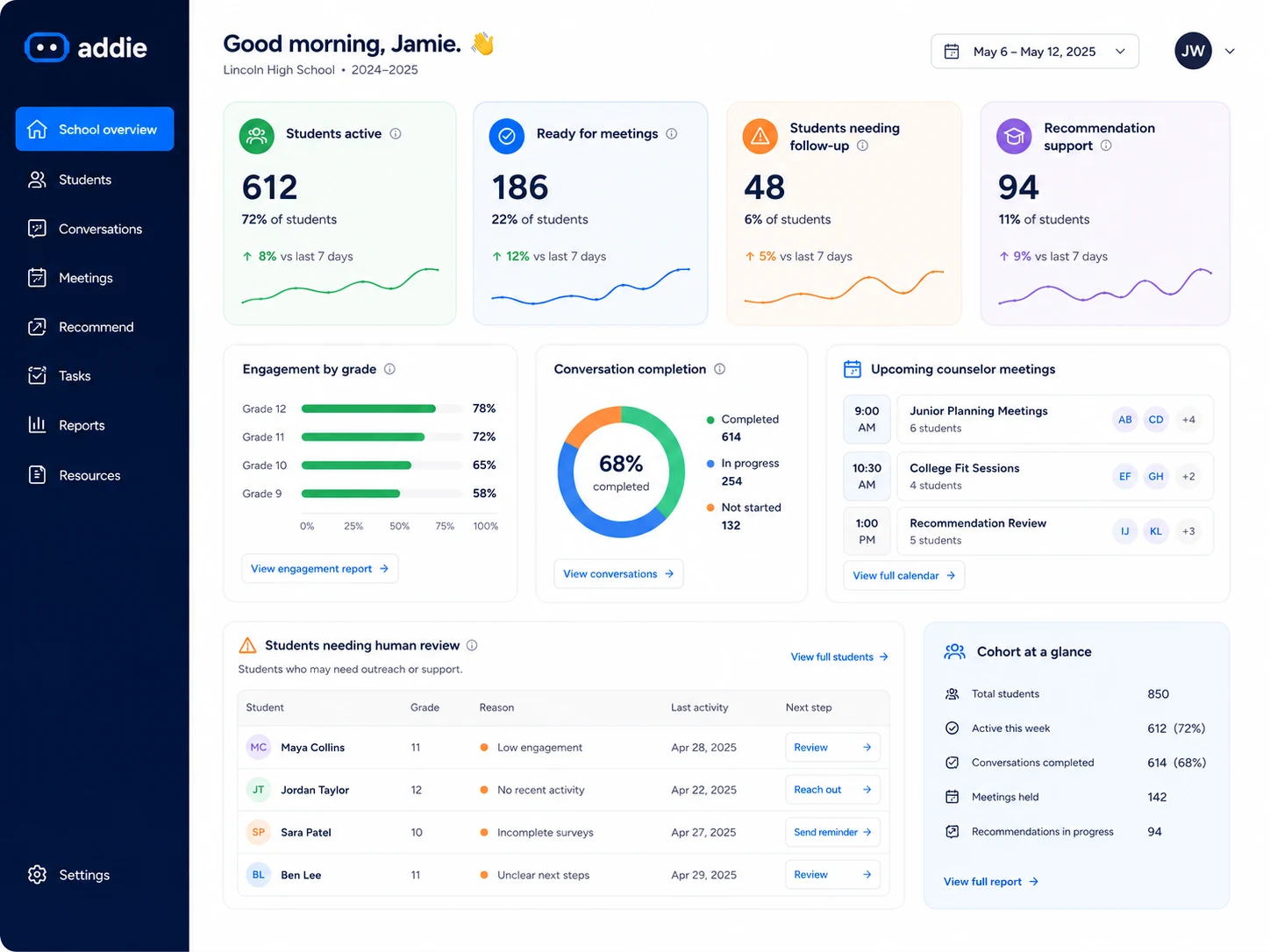
A schoolwide view of who is engaging and where human attention should go next—plus a complete record for every student.
Across the caseload
Know where a human should step in
See who is active, stalled, ready for a meeting, or asking for support—without manually checking every student.
Before meetings
Start with context instead of collecting it
Know what changed, what matters now, and which questions are worth the student’s limited meeting time.
Before recommendations
Find the stories and evidence faster
Move from scattered forms and notes to organized themes, quotations, teacher evidence, and possible structure.
Across the program
See whether the work is actually moving
Track engagement, conversation completion, upcoming priorities, and whether counselors are receiving useful context.
Built around the counseling calendar
How Addie fits what you already do
You already have the work—forms, meetings, notes, letters, deadlines. Addie makes it richer, faster, and more connected.
Student understanding
Junior intake
Before Addie
A static questionnaire—brief facts the counselor still has to unpack.
With Addie
A guided conversation on why it mattered, what changed, what the student wants understood.
Counselor outcome: richer context before the first major meeting.
Human conversations
Counselor meetings
Before Addie
Scarce meeting time spent gathering background and remembering what happened last time.
With Addie
The counselor opens to a concise brief—what changed, and what's worth exploring.
Counselor outcome: a less rushed, more meaningful meeting.
Best fit
College and pathway exploration
Before Addie
Preferences and impressions scattered across spreadsheets, systems, and memory.
With Addie
Fit criteria grounded in years of student voice—environments, values, community, constraints.
Counselor outcome: choices grounded in where the student may truly thrive.
High-value writing
Recommendation preparation
Before Addie
Reassembling questionnaires, comments, notes, and prior drafts from scratch.
With Addie
Stories, quotations, and evidence already organized in one counselor-ready record.
Counselor outcome: faster preparation with judgment, voice, and authorship intact.
Same work. No more disconnected artifacts.
Questionnaires, meeting notes, recommendation evidence, list research, and follow-up all strengthen the same Student Ledger instead of disappearing into separate folders.
A complete counseling program for Grades 9–12
One program. Four years of growing context.
Know. Explore. Plan. Act. Addie does different developmental work at each grade, while every year adds useful evidence to the same Student Ledger.
GRADE 9Start with belonging and learning
GRADE 10Test values and possible futures
GRADE 11Turn self-knowledge into fit and direction
GRADE 12Use the complete story to act
Grade 9
Know
Belonging & learning
BelongingHow I learnTrusted adults
What the program makes possible
See where each student is connected, how they seek help, and what would make Grade 10 stronger.
By Grade 11, the counselor is not starting from a blank autobiography.
The team inherits a student-confirmed record of belonging, learning, values, tested interests, fit, stories, support, and change over time.
Examples from Addie’s grade-level conversation library
How Addie captures student voice, year by year.
These are examples of the thoughtful conversations Addie can deliver by phone, browser, WhatsApp, or text. Each one captures a real experience, helps the student make meaning, and adds counselor-ready context to the Ledger.
Grade 9 · KNOW
Belonging and becoming
Where do I belong, how do I learn, and what helps me grow here?
Addie begins by helping the student locate themselves in the transition—not by asking for a polished identity statement.
A question Addie might explore“What feels exciting, uncertain, or unfinished as you begin high school?”
What the student works through
What feels new or different
One source of energy and one source of uncertainty
What they want an adult to understand
How they prefer to reflect and receive support
What enters the Ledger
Student-defined starting point
Early priorities and concerns
Communication preferences
One student-owned question
What the counselor can do
Begin the year warm, not cold
See who may need an early check-in
Avoid assuming every transition looks the same
Frame the next human interaction around the student’s words
What this replaces or improves
A generic orientation survey or first meeting spent reconstructing how the transition is going.
ResultA student-owned baseline for the first year of high school.
Conversation 2
Finding My Place
Students identify where connection is beginning—and where it is not—through a concrete experience rather than a rating alone.
A question Addie might explore“Tell me about one moment this term when you felt most like yourself at school.”
What the student works through
People, places, classes, or activities that create belonging
Moments of comfort and friction
Where the student feels known or unseen
What would make the school feel more like theirs
What enters the Ledger
Belonging evidence
Early friction
Student language about school culture
Possible relationship gaps
What the counselor can do
Identify students without a foothold
Notice missing adult or peer connections
Prepare a specific follow-up
Strengthen advisory and transition support
What this replaces or improves
A belonging score without the story or conditions behind it.
ResultA practical map of where the student is beginning to connect.
Conversation 3
How I Learn Here
The student reflects on real academic experiences, including when learning felt effective, difficult, or dependent on support.
A question Addie might explore“Describe a class or task that taught you something about how your brain works.”
What the student works through
Learning conditions that help
One academic adjustment
How they ask for help
A strategy worth continuing or changing
What enters the Ledger
Learning conditions
Help-seeking pattern
Teacher or support relationship
Student-selected strategy
What the counselor can do
Make course and study conversations specific
See when grades hide a learning barrier
Reinforce effective help-seeking
Connect the student with the right adult
What this replaces or improves
Course planning based only on grades and requirements.
ResultA learner profile that can guide courses, support, and adult relationships.
Conversation 4
People Who Know Me
Addie helps the student identify the web of adults, peers, teams, and communities that supports them.
A question Addie might explore“Who at school really gets you—and what do they do that makes you feel known?”
What the student works through
Trusted adults and peers
Contexts where they feel supported or challenged
Where they feel invisible
One relationship they want to strengthen
What enters the Ledger
Relationship map
Trusted-adult evidence
Support preferences
One possible adult move
What the counselor can do
See who has a key adult
Identify relationship gaps
Coordinate with advisors or teachers
Make follow-up more personal
What this replaces or improves
Assuming that every student already has a meaningful adult connection.
ResultA relationship map that helps the school make belonging actionable.
Conversation 5
How I Contribute
Contribution reveals strengths that may not appear in a transcript: inclusion, responsibility, initiative, creativity, and care.
A question Addie might explore“When did you make a class, team, group, or community better?”
What the student works through
A concrete contribution
Who was affected
What the student did and why
What the moment revealed
What enters the Ledger
Contribution story
Demonstrated strength
Values in action
Student quote
What the counselor can do
Recognize strengths that grades miss
Offer specific encouragement
Connect the student with future roles
Build a richer longitudinal story
What this replaces or improves
A strengths inventory made of adjectives without evidence.
ResultA concrete example of how the student affects other people and communities.
Conversation 6
Carry Forward
The student reviews the year, chooses what to preserve or change, and identifies one realistic next step.
A question Addie might explore“What is one habit, relationship, or strength you want to bring into Grade 10?”
What the student works through
What changed during Grade 9
What should continue
One habit or relationship to strengthen
Support needed for Grade 10
What enters the Ledger
Year-end reflection
One student-owned intention
Transition support request
Confirmed Grade 10 handoff
What the counselor can do
Prepare the transition
Share relevant context with the next adult
Close the loop on support
Enter Grade 10 with a clear starting point
What this replaces or improves
A year-end transition that relies on memory or generic advice.
ResultA Belonging & Learning Profile the student can confirm and carry forward.
Grade 10 · EXPLORE
Reflective intelligence and purpose
What matters to me, how does it show up, and what will I test next?
Year-end Ledger outputPersonal Rubric + Next Experiment
Conversation 1
Change & Continuity
Students compare their current experience with earlier reflections and learn to treat identity as a working theory, not a permanent label.
A question Addie might explore“What has changed since last year—and what still feels true?”
What the student works through
Growth and continuity
New relationships or responsibilities
What no longer fits
Evidence for perceived change
What enters the Ledger
Student-confirmed changes
Stable themes
Emerging questions
Longitudinal comparison
What the counselor can do
See what is genuinely evolving
Avoid stale assumptions
Ask better transition questions
Connect current choices to prior evidence
What this replaces or improves
Starting each year with a blank questionnaire.
ResultA student-confirmed picture of what is stable and what is emerging.
Conversation 2
Values in Action
A value becomes useful when the student can show where it appeared, why it mattered, and what tension it created.
A question Addie might explore“Choose one thing you say matters. Tell me about a recent choice that proves it.”
What the student works through
A value supported by a real choice
Competing priorities
Why the moment mattered
What they would do again or differently
What enters the Ledger
Value + concrete evidence
Student interpretation
Tension or tradeoff
Direct quotation
What the counselor can do
Understand motivations beneath activities
Connect values to courses and communities
Use evidence rather than labels
Prepare future fit conversations
What this replaces or improves
A form that ranks values but never asks where they show up.
ResultValues grounded in behavior, not just attractive words.
Conversation 3
How I Learn and Grow
The student identifies patterns in motivation, challenge, help-seeking, and self-regulation before junior-year decisions intensify.
A question Addie might explore“When did you have to change the way you learned or ask for help?”
What the student works through
A meaningful academic challenge
Strategy change
How and when they seek help
What support made a difference
What enters the Ledger
Learning pattern
Response to difficulty
Support preference
Strategy to test
What the counselor can do
Improve course-selection guidance
See sustainable versus brittle performance
Connect the student with resources
Build recommendation-ready evidence of growth
What this replaces or improves
Academic planning based only on grades, rigor, or requirements.
ResultA clearer theory of how the student learns and adapts.
Conversation 4
Possible Versions of My Future
Students explore multiple futures without being forced to choose a major or career before they have enough evidence.
A question Addie might explore“Imagine three futures that each feel plausible. What attracts you to each?”
What the student works through
Two or three plausible future selves
What attracts them to each
Family, financial, and cultural influences
What they still need to learn
What enters the Ledger
Possible-futures map
Sources of curiosity
Constraints and assumptions
Questions for exploration
What the counselor can do
Expand the option set
Challenge inherited assumptions
Connect interests to courses and people
Keep uncertainty productive
What this replaces or improves
A career inventory that produces a result without reflection or strategy.
ResultA curiosity map rather than a prematurely fixed plan.
Conversation 5
A Question I Want to Test
The student chooses a small experiment—a course, project, conversation, activity, service opportunity, or observation—that can generate new evidence.
A question Addie might explore“What is one question about yourself or your future that you could test in the next eight weeks?”
What the student works through
One meaningful question
A specific experiment
Success and learning criteria
Adult or resource support
What enters the Ledger
Testable question
Experiment plan
Support owner
Follow-up date
What the counselor can do
Move exploration into action
Suggest realistic opportunities
Track what the student learns
Avoid advice that never gets tested
What this replaces or improves
Inspiration without a next step.
ResultOne student-owned experiment that makes a possible future more or less plausible.
Conversation 6
My Personal Rubric
The student synthesizes evidence into a provisional rubric that is designed to evolve rather than lock identity in place.
A question Addie might explore“What conditions help you learn, belong, and contribute—and what should you test next?”
What the student works through
Learning and belonging conditions
Values with evidence
Interests tested
Tensions, tradeoffs, and next questions
What enters the Ledger
Personal rubric
Confirmed patterns
Open questions
Grade 11 handoff
What the counselor can do
Enter Grade 11 with shared language
Guide courses and activities from evidence
Build future-fit hypotheses
Identify what remains unresolved
What this replaces or improves
A sophomore profile that is either too generic or treated as permanent.
ResultA Personal Rubric + Next Experiment for the transition into Grade 11.
Grade 11 · PLAN
Well-being, fit, and story
What environments help me thrive—and what evidence supports that?
Year-end Ledger outputCounselor-Ready Fit & Story Map
Conversation 1
Starting Point
Addie learns what the student has already explored, who is influencing the process, and what the student wants the counselor to understand.
A question Addie might explore“What feels exciting, confusing, or unfinished as you begin this process?”
What the student works through
Current readiness
Sources of momentum and uncertainty
Family and outside influences
What they want from counseling
What enters the Ledger
Junior-year starting point
Open questions
Influence map
Student priorities
What the counselor can do
Begin the first major meeting further ahead
See where confusion is real
Avoid repeating work already done
Clarify the human agenda
What this replaces or improves
A thin junior questionnaire or a cold first meeting.
ResultA warm starting point for the busiest counseling year.
Conversation 2
Academic Strengths & Sustainable Performance
Students reflect on strengths, workload, stress signals, sleep, boundaries, support, and the conditions that produce sustainable performance.
A question Addie might explore“When did you do demanding work without losing yourself?”
What the student works through
Academic strengths with evidence
Workload and stress patterns
Support and help-seeking
Habits and boundaries
What enters the Ledger
Learner profile
Sustainability signals
Growth story
Support needs
What the counselor can do
Guide rigor and course choices
See when achievement is unsustainable
Prepare recommendation evidence
Plan human support
What this replaces or improves
A transcript-only understanding of academic identity.
ResultEvidence for both academic advising and student well-being.
Conversation 3
Life Outside the Classroom
Activities become stories about contribution, family roles, work, responsibility, leadership, and growth—not another list of accomplishments.
A question Addie might explore“What do you do outside class that has shaped who you are—and why?”
What the student works through
Activities, work, service, hobbies, and family roles
Which experiences matter most and why
Initiative and invisible responsibility
What they want to continue or change
What enters the Ledger
Narrative evidence
Contribution and leadership
Values through action
Recommendation and essay stories
What the counselor can do
See beyond credentials
Recognize context behind time use
Find authentic stories
Prepare recommendations
What this replaces or improves
A brag sheet that records what happened but not why it mattered.
ResultA richer story bank grounded in real experience.
Conversation 4
Future Path
Students connect subjects, interests, values, and practical context to possible majors, careers, or other postsecondary pathways.
A question Addie might explore“What kinds of problems, topics, or environments could you imagine wanting to work with?”
What the student works through
Fields and problems that feel compelling
Why they appeal
Family, financial, geographic, and identity context
What remains uncertain
What enters the Ledger
Pathway hypotheses
Motivations
Constraints
Questions to investigate
What the counselor can do
Broaden and narrow intelligently
Connect students with resources
Avoid premature certainty
Ground next research
What this replaces or improves
A major or career answer produced before the student has enough evidence.
ResultLanguage for what feels possible, meaningful, and unresolved.
Conversation 5
College Fit in My Own Words
Named colleges become examples of preferences. Addie helps the student define academic, social, geographic, cultural, financial, and support conditions.
A question Addie might explore“What parts of your current school experience would you want again—and what would you change?”
What the student works through
Academic and social preferences
Community, size, setting, and support
What to repeat or change from high school
Family and practical constraints
What enters the Ledger
Fit criteria with evidence
Why named schools appeal
Constraints and tradeoffs
List hypotheses
What the counselor can do
Build and challenge the list
See when prestige is substituting for fit
Make research more focused
Prepare family conversations
What this replaces or improves
A spreadsheet of school names with no durable record of the reasoning behind them.
ResultA student-defined picture of fit—not just a list.
Conversation 6
Story & Support Map
The student and Addie identify the stories, open questions, support plan, and recommendation evidence that should move forward.
A question Addie might explore“Which stories, supports, and questions should your counselor carry into summer?”
What the student works through
Stories worth preserving
Open fit and pathway questions
Support needs
Summer priorities
What enters the Ledger
Story bank
Recommendation evidence
Support plan
Grade 12 handoff
What the counselor can do
Prepare recommendations
Plan summer work
Set meeting priorities
Start Grade 12 with continuity
What this replaces or improves
A summer handoff that relies on a last-minute autobiography.
ResultA Counselor-Ready Fit & Story Map for list work, recommendations, and Grade 12.
Grade 12 · ACT
Application, decisions, and transition
What has changed in me, what have I contributed, and what am I ready to carry forward?
Addie surfaces themes, quotations, tensions, and supporting evidence. Students write their essays; counselors author recommendations.
A question Addie might explore“Which experiences best show how you think, contribute, or respond to difficulty?”
What the student works through
Student-owned themes
Promising stories
Tensions and growth
Language worth preserving
What enters the Ledger
Story bank
Direct quotations
Teacher evidence
Possible structure
What the counselor can do
Begin workshop and writing work closer to insight
Structure recommendations efficiently
Protect student and counselor authorship
Retain nuance
What this replaces or improves
Hours of copy-and-paste from forms, comments, notes, and prior drafts.
ResultCounselor-ready evidence and direction—not AI-authored final work.
Conversation 5
Decision & Fit Reflection
The student revisits their fit criteria, constraints, support needs, and values when comparing real options.
A question Addie might explore“What does each option make possible—and what tradeoffs are you accepting?”
What the student works through
Decision criteria
Tradeoffs
Family and financial context
What each option honors
What enters the Ledger
Decision rationale
Updated fit criteria
Support and transition needs
Student-confirmed choice context
What the counselor can do
Help the student compare consistently
Surface hidden pressures
Keep the student’s values central
Support the family conversation
What this replaces or improves
A decision process dominated by rankings, fear, or the loudest outside voice.
ResultA reasoned decision grounded in the student’s own evidence.
Conversation 6
Transition & Legacy
The final conversation captures gratitude, unfinished business, transition support, legacy, and the student’s next identity chapter.
A question Addie might explore“What does your choice honor, and how do you want to leave your school?”
What the student works through
Transition needs
What they want to carry forward
Gratitude and legacy
Unfinished questions
What enters the Ledger
Final student synthesis
Transition plan
Legacy reflection
Student-owned closing record
What the counselor can do
Support the handoff beyond graduation
Close relationships intentionally
Identify transition risks
Preserve a student-confirmed longitudinal story
What this replaces or improves
A transactional end to the process once the decision is made.
ResultAn Application & Transition Dossier that closes the four-year journey and supports what comes next.
What the experience feels like
A reflection experience that feels personal—not like another form.
Students can use voice or text, pause and return, and think out loud without having to perform a polished answer on the first try.
Voice or textPause and returnHuman follow-up
These are examples—not a rigid six-conversation requirement.
Schools choose the grade journeys and timing that fit their calendar. The product provides proven prompts and a consistent reflection structure without asking the school to invent a new curriculum.
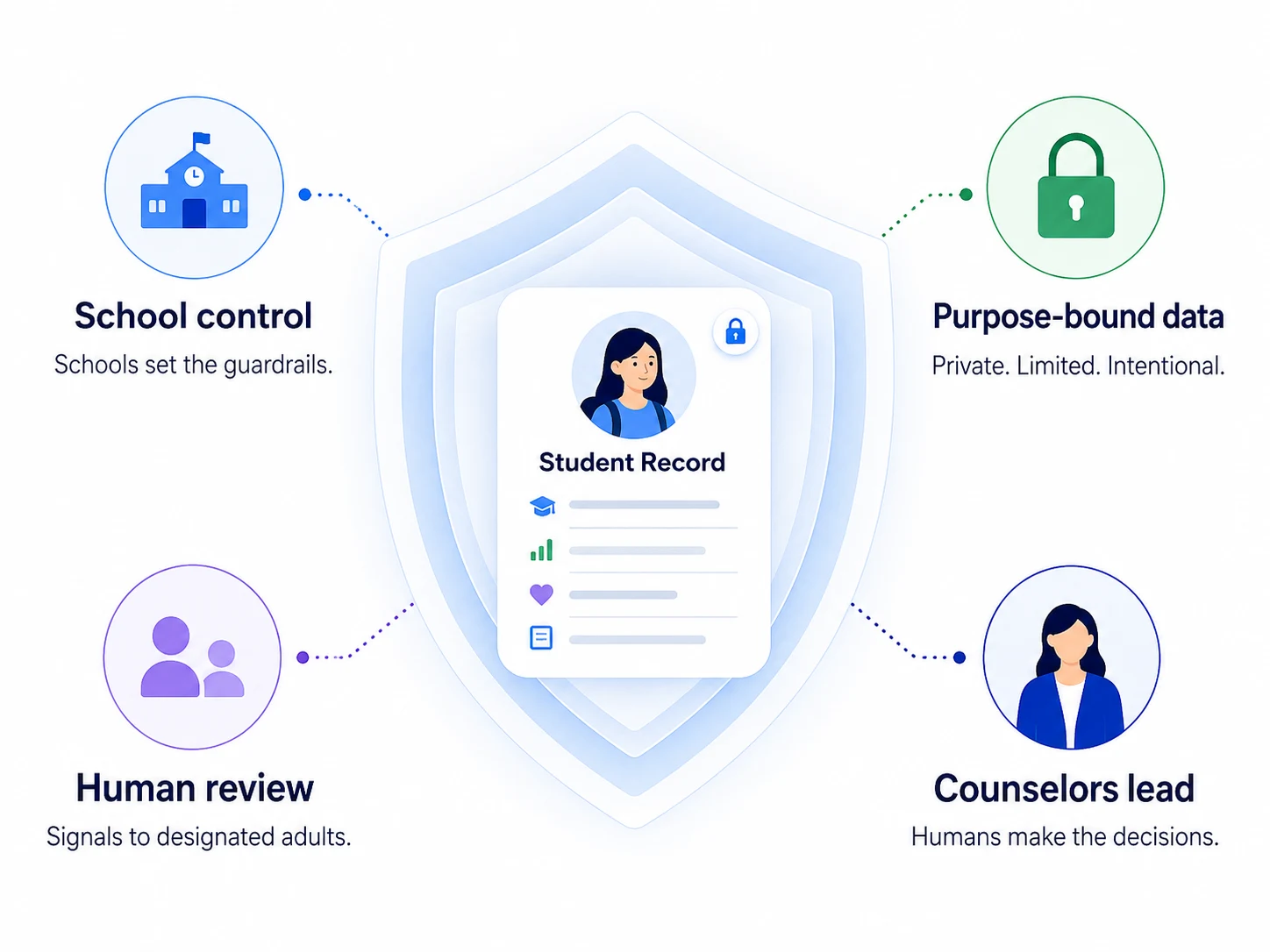
Built so schools can use AI without surrendering student privacy, counselor judgment, or control of the counseling process.
The school stays in control
The school determines participating students, enabled information, users, communication, and launch timing.
Student information stays purpose-bound
Counselor notes remain restricted, access is role-based, and student data is not used to train public models.
Human-reportable concerns reach humans
Under the school’s agreed protocol, Addie can alert designated staff when an interaction needs human review. A trained adult decides what happens next.
Context is not diagnosis
Student-reported stress, belonging, confidence, relationships, or support needs can become visible for counselor follow-up. Addie is not therapy, clinical care, or emergency response.
Humans make the decisions
Addie organizes, summarizes, and proposes. Counselors interpret, author, advise, decide, and lead the relationship.
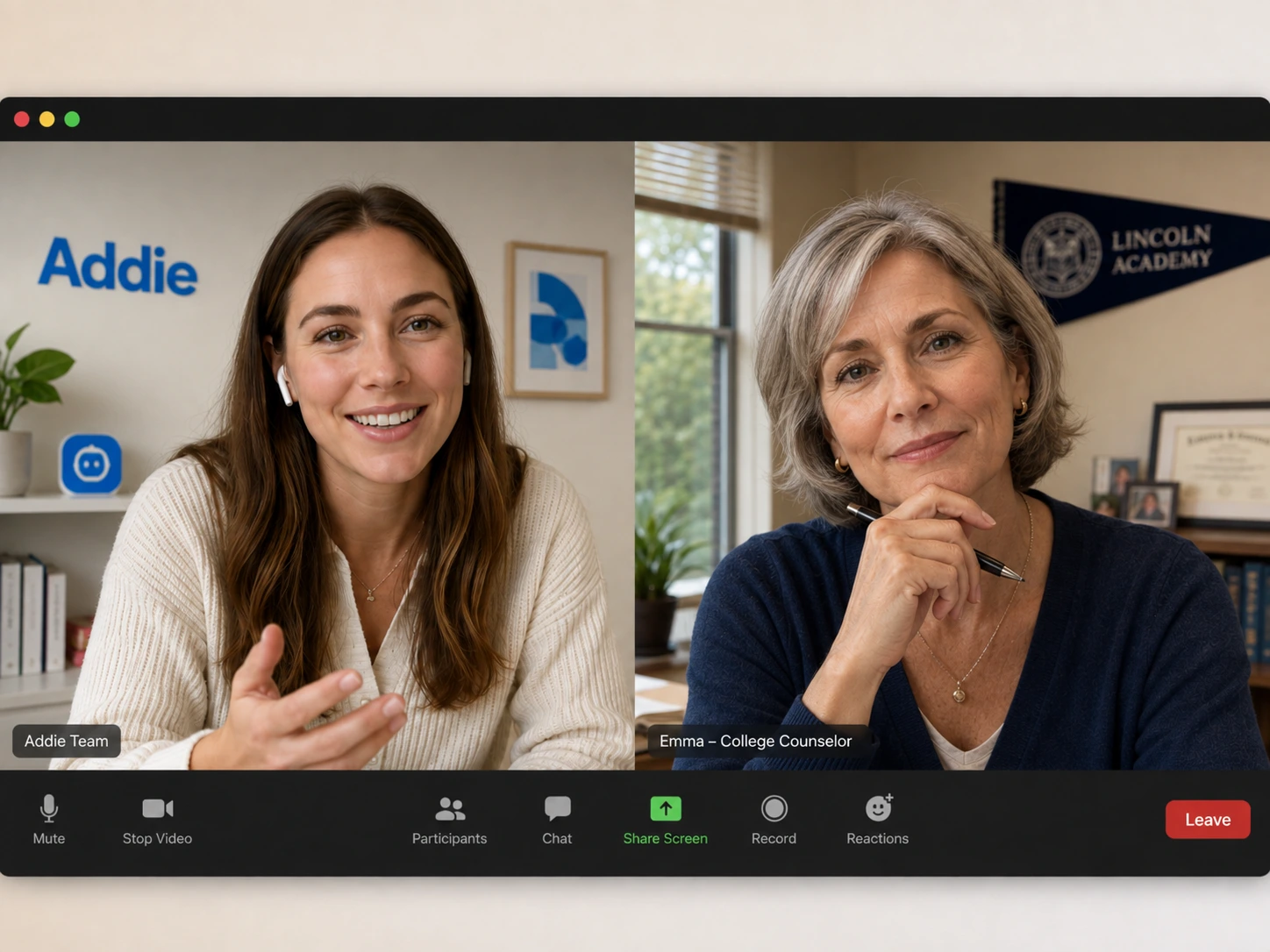
Configure Addie with a member of our team in 30 minutes.
A real Addie team member works live with your counselors to connect the proven grade journeys to your calendar, add users, set dates, and teach the team to run the account. Addie then works alongside the workflows you already own.
A real Addie team member configures the account with your counselors—on screen, in the real product.
You are not handed software and left alone
We configure the real account together while your team learns how to choose journeys, schedule work, send prompts, review engagement, and make changes independently.
1
Select the grade journeys
Choose Grade 9, 10, 11, 12—or a combination.
2
Set dates and assignments
Align conversations, voice-note prompts, and tasks to the school calendar.
3
Add counselors and students
Use a secure roster and confirm assignments, permissions, and communication.
4
Learn to launch independently
Change dates, send prompts, review progress, and manage the account without waiting for Addie.
Before the callBring the grades, first date, school owner, counselor assignments, and roster/data contact.
During the callConfigure the real account together and connect Addie to the school work already on the calendar.
Leave withA launch-ready account, trained counselors, scheduled journeys, and a team able to operate independently.
See the product first—or start the configuration conversation.
We will show exactly how Addie fits your grades, calendar, and counseling priorities.
Addie works alongside the SIS and college-counseling platforms your team already uses. Start with a secure roster, reuse approved context, and deepen connectivity only when it creates real workflow value.
No rip-and-replace. No platform reset. Addie adds student reflection and counselor-ready context around the workflows already living in your school ecosystem. These logos identify systems Addie can work alongside; no partnership or endorsement is implied.
1
Secure roster
The fastest path for verified students, counselors, grades, IDs, and assignments.
2
Roster + approved context
Add transcripts, teacher comments, questionnaires, and approved records without a systems project.
3
Recurring export or OneRoster
Refresh rosters, assignments, and approved fields on an agreed cadence as deployment grows.
4
API, SSO, or writeback
Go deeper only when scale, governance, or workflow value clearly justifies the added complexity.
Implementation principleChoose the smallest reliable dataset that creates correct accounts, permissions, and counselor routing.
A deeper integration is never required to begin safely.
Vendor names and logos are trademarks of their respective owners. No partnership or endorsement is implied. Technical paths vary by school configuration and approved access.
Help every stakeholder evaluate Addie
Choose the role closest to yours, then share the supporting PDFs that answer the next internal question.
College counseling leaders
What changes for students and counselors?
See the grade journeys, counselor workflows, Student Ledger, and evidence from peer schools.
The questions counseling teams ask when deciding whether Addie is worth bringing into the program.
Does Addie replace college counselors?
No. Addie gives students structured time to reflect, connects school-approved context, and prepares counselor-ready summaries. Counselors retain the relationship, interpretation, authorship, judgment, and every consequential decision.
Will students actually engage?
At Lakeside School, 132 of 140 juniors completed all ten conversations and generated more than 600 hours of reflection. Strong school framing, a real deadline, and visible counselor use are central to engagement.
What do counselors receive?
Counselors receive cohort-level visibility, a living Student Ledger, meeting preparation, recommendation support, fit insight, and clear signals about who may need human follow-up.
Can Addie help counselors notice concerns earlier?
Yes. Regular reflection can surface belonging, confidence, stress, relationships, or support needs, and human-reportable concerns can be routed to designated adults under the school’s agreed protocol.
Do we need an SIS integration to begin?
No. Most schools can begin safely with a secure roster and approved context. Deeper integrations are added only when they create useful operational value.
How quickly can a school launch?
A roster-first launch can often move in days rather than months. The school names a champion and cohort, completes a 30-minute alignment session, approves communication, and launches around its existing calendar.
How is student information protected?
The school controls purpose, scope, cohorts, enabled information, access, and communication. Student data is not used to train public models. Read the Privacy Policy.
What does getting started require?
Choose the grade or grades, a first launch date, the school owner, and the counselor assignments. In a 30-minute configuration and training session, we set up the journeys, dates, roster, communication, and permissions with your team.
Turn scattered student information into better counseling.
In a 30-minute demo, we will show how Addie connects your existing work, what students experience at each grade, and how your team can get started without a custom implementation project.
Book a demoSee the student and counselor experience